
What Is Red Light Therapy Good For? Here’s What the Research Actually Supports
Skin? Hair? Pain? Recovery? Relaxation? Let’s talk about what red light therapy may actually help with—and where the hype gets ahead of the research.
What is red light therapy good for?
Research suggests that specific red and near-infrared light therapy protocols may support skin rejuvenation and certain types of hair loss, while evidence for pain, exercise recovery, and broader whole-body wellness benefits varies depending on the device, dose, treatment area, and protocol.
If you’ve spent five minutes on social media lately, you might think red light therapy can do just about everything but make your morning coffee.
Better skin. Less pain. Hair growth. Faster recovery. More energy. Better sleep. The list of claims gets long very quickly.
Some of the research really is interesting. Some of the claims? Not so much.
Red and near-infrared light therapy—often called photobiomodulation—has been studied for a variety of uses. However, the strength of the evidence is not the same for every benefit, every device, or every treatment goal.
And that distinction matters.
A small light used on the scalp isn’t automatically equivalent to a full-body light pod. A protocol studied for facial skin doesn’t prove that every red-light device produces the same result.
At Revive Wellness & Beauty in Powell, Ohio, we would rather explain that difference than hand you a giant list of things red light supposedly does.
So let’s separate the research from the hype.
________
Okay—So What Is Red Light Therapy Actually Good For?
1. Want Better-Looking Skin? This Is One of the More Interesting Uses.
Skin rejuvenation is one of the better-studied cosmetic applications of photobiomodulation.
Clinical research using specific red-light protocols has reported improvements in measures such as wrinkle appearance, skin roughness, and collagen density. One randomized clinical trial involving 137 women found a reduction in periocular wrinkle volume after a defined course of red-light treatments.
However, this is where context matters.
The study used specific wavelengths, doses, treatment areas, and schedules. We should not assume that every mask, panel, or full-body red-light system will reproduce the same results.
A more realistic way to think about red light therapy is that it may be one non-invasive tool for supporting certain skin-rejuvenation goals.
It doesn’t replace sunscreen, good skincare, or other treatments when those make more sense.
2. What About Hair Growth?
Possibly—but first we need to know why you’re losing your hair.
Low-level light therapy has evidence supporting improved hair density in androgenetic alopecia, commonly called pattern hair loss.
That does not mean red light is proven for every type of shedding.
So instead of immediately asking, “Should I use red light for my hair?” start with:
“Why am I losing my hair in the first place?”
That answer may completely change the recommendation.
3. What About Pain, Inflammation, Soreness and Workout Recovery?
This is an area where the internet can make red light therapy sound much simpler than the research actually is.
Photobiomodulation has been studied in relation to pain, inflammatory processes, muscle soreness, and recovery. However, treatment location, wavelength, dose and device matter.
In particular, research using light directly over a specific muscle or treatment area should not automatically be used to promise the same outcome from a full-body pod.
That distinction becomes especially important with workout recovery.
A 2025 systematic review specifically examined whole-body photobiomodulation for exercise performance and recovery. Only five studies involving 105 physically active participants met the review criteria, and the review did not find evidence of improved fatigue biomarkers or exercise performance.
So if someone tells you a full-body red-light session is guaranteed to eliminate pain, reduce inflammation, or dramatically improve athletic recovery, we’d be cautious with that promise.
The research is more nuanced than that.
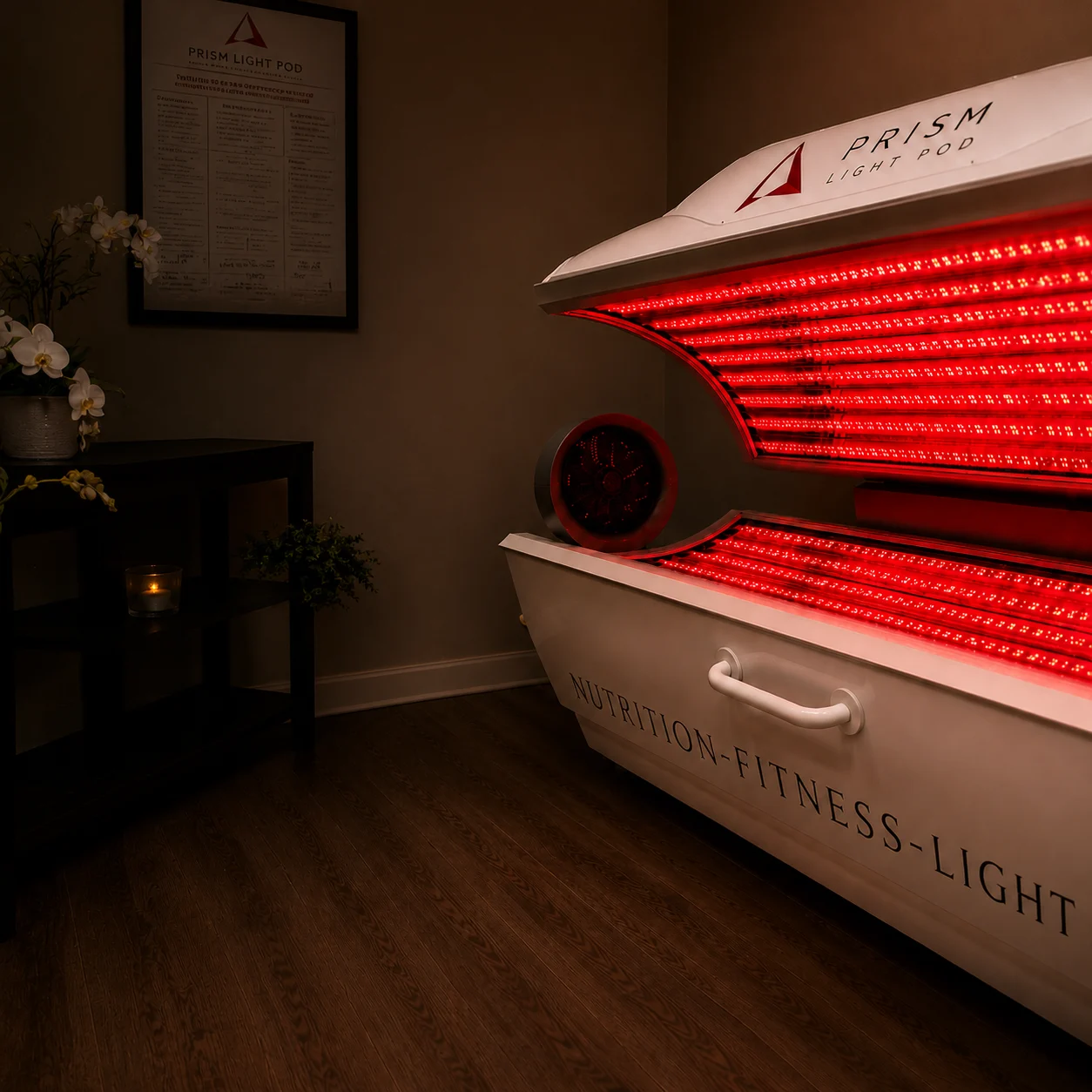
4. What Does a Full-Body Red Light Therapy Session at Revive Actually Feel Like?
This is the part people often want to know before their first appointment.
Do I have to get undressed? Is it hot? What do I do in there?
At Revive, you undress to your comfort level. Because clothing blocks light from reaching covered skin, many clients choose to use the pod nude or wearing only underwear.
You’ll also wear protective eyewear during your session.
Then you lie back.
That’s pretty much it.
There are no needles. There is no procedure being performed while you’re lying there. And unlike an infrared sauna, the red light pod isn’t hot.
Many of our clients simply find the experience relaxing.
For a little while, there are no emails to answer, no phone to check and nowhere else you need to be.
You just lie there and relax.
And sometimes, that alone feels pretty good.
5. What About All the Talk About Mitochondria and “Cellular Energy”?
If you start researching red light therapy, it won’t take long before you encounter words like mitochondria, ATP and “cellular energy.”
There is legitimate science behind why researchers discuss these mechanisms. Photobiomodulation research examines interactions between light and cellular signaling, including mitochondrial pathways.
But here’s the part that often disappears in marketing:
A biological mechanism doesn’t automatically prove every advertised benefit.
Understanding what might happen at a cellular level can help researchers explain why photobiomodulation deserves study.
Clinical outcomes tell us what we can responsibly say it actually does for people.
Those aren’t always the same thing.
6. Is a Full-Body Light Pod the Same as a Face Mask or Scalp Device?
No—and this may be the most important thing to understand about red light therapy.
Many studies treat one specific area: the face, scalp, knee, shoulder, or a particular muscle group.
Researchers also control variables such as wavelength, dose, irradiance and treatment schedule.
A full-body system exposes a much larger area.
That is why we shouldn’t take every benefit demonstrated with a localized research device and automatically claim that every full-body pod provides the same benefit.
Same color of light doesn’t necessarily mean same treatment.
Device, wavelength, dose, treatment area and goal all matter.
7. So…Is Red Light Therapy Worth Trying?
For some people, absolutely.
But the better question is:
“What am I hoping to get from it?”
For skin concerns, specific photobiomodulation protocols have encouraging clinical research.
When pattern hair loss is the concern, low-level light therapy also has evidence worth discussing.
On the other hand, if someone promises that a full-body pod will detox the body, melt fat, balance hormones, cure pain and make you a better athlete—now we’re in very different territory.
And maybe your reason is much simpler.
Perhaps you want a non-invasive wellness service that lets you lie down, unplug and relax for a little while.
That is okay too.
Not every wellness experience needs a miracle claim attached to it.
________
Questions to Ask Before Starting Red Light Therapy
- What am I hoping red light therapy will help with?
- Is there research for that specific goal?
- Was that research done with localized or whole-body treatment?
- What type of red and near-infrared light does this device use?
- What treatment duration is recommended for this particular system?
- Are there medications, eye conditions, photosensitivity concerns or medical issues I should mention?
- What should I realistically expect?
- How will I know whether it is providing value for me?
Those questions are much more useful than simply asking whether “red light works.”
________
Red Light Therapy Claims That Should Make You Raise an Eyebrow
Be cautious when you see claims that red light therapy:
- Detoxes the body
- Melts fat or guarantees weight loss
- Balances hormones
- Prevents disease
- Treats every type of hair loss
- Replaces medical care for pain, disease, or injury
- Is proven to improve whole-body athletic performance
- Produces the same results regardless of wavelength, dose, device, or schedule
- Works exactly the same way for everyone
Good wellness education should explain both what we know and what we do not know.
________
Why Explore Red Light Therapy at Revive?
If you’re looking for red light therapy in Powell, Ohio, we want you to understand what you’re doing—and why you’re doing it.
At Revive, our full-body red and near-infrared light therapy system offers a comfortable, non-invasive way to incorporate light therapy into your wellness routine.
But having the technology doesn’t mean we’re going to tell you it does everything.
Instead, we start with your goal.
Interested in skin? Let’s talk about what the research supports.
Concerned about hair loss? First, let’s consider what may be causing it.
Interested in pain or recovery? We’ll explain why research on localized photobiomodulation isn’t necessarily the same as research on full-body systems.
Or maybe you simply want to take a break, lie down and relax.
No miracle list. No pretending one device fixes everything.
Just an informed conversation about whether red light therapy makes sense for you.
________
Stop Asking “Does Red Light Work?”
Instead, ask:
“Does red light therapy have evidence for the specific thing I want it to do?”
That answer may be different for skin, hair, pain, muscle recovery or general wellness.
Photobiomodulation is a legitimate and active area of scientific research.
It’s also an area where marketing sometimes moves faster than science.
You can be interested in red light therapy without believing every claim you see online.
Actually, we think that’s a pretty smart way to approach wellness in general.
________
Frequently Asked Questions
What is red light therapy good for?
Research on photobiomodulation supports some specific applications more strongly than others. Certain protocols have evidence related to skin rejuvenation and androgenetic hair loss, while evidence for generalized whole-body benefits is less established.
Is red light therapy good for skin?
Specific red-light protocols have shown improvements in measures such as wrinkle appearance and skin roughness. However, results from one device or research protocol shouldn’t automatically be generalized to every red-light system.
Can red light therapy help with pain or inflammation?
Researchers have studied photobiomodulation for a variety of pain and inflammatory conditions. However, results depend on the condition, device, treatment area and protocol. Evidence from localized treatment shouldn’t automatically be used to promise the same outcome from a full-body system.
Can red light therapy grow hair?
Low-level light therapy has evidence for androgenetic or pattern hair loss. That does not mean it is proven for every cause of hair shedding.
Is the red light therapy pod hot?
No. Revive’s full-body red light therapy experience is not like sitting in an infrared sauna. Clients generally find the session comfortable and relaxing.
What do I wear during red light therapy?
You can undress to your comfort level. Because clothing prevents light from reaching covered skin, many clients choose to use the pod nude or wearing underwear. Protective eyewear is worn during the session.
Is there downtime?
Red and near-infrared light therapy is non-invasive and does not generally involve procedural downtime.
How often should I use red light therapy?
There isn’t one universal schedule for every device and every goal. Treatment protocols vary, so frequency should reflect the specific system and intended use rather than assuming more is always better.
Is red light therapy safe?
Photobiomodulation is non-invasive, but individual considerations still matter. Medications, photosensitivity, eye considerations and health history are among the reasons to review appropriate precautions before treatment.
________
Medical References
Mota LR, et al. Photobiomodulation Reduces Periocular Wrinkle Volume by 30%: A Randomized Controlled Trial. Photobiomodulation, Photomedicine, and Laser Surgery. 2023;41(2):48–56. Read the study on PubMed.
Álvarez-Martínez M, Borden G. A Systematic Review on Whole-Body Photobiomodulation for Exercise Performance and Recovery. Lasers in Medical Science. 2025;40(1):55. Read the review on PubMed.
Low-Level Laser and LED Therapy in Alopecia: A Systematic Review and Meta-Analysis. Lasers in Medical Science. 2024. PMID: 39404126.
Glass GE. Photobiomodulation: A Systematic Review of the Oncologic Safety of Low-Level Light Therapy for Aesthetic Skin Rejuvenation. Aesthetic Surgery Journal. 2023;43(5):NP357–NP371.
________
Curious Whether Red Light Therapy Belongs in Your Routine?
You don’t need to sort through every red-light claim on social media before trying a session.
Start with one question:
What are you hoping to get from it?
Maybe you’re interested in the research around skin or hair. Maybe you’re exploring red light as part of your wellness routine.
Or maybe you just want to lie down, unplug and relax for a little while.
We’ll explain our full-body system, what you can expect during a session, where the research is encouraging and where expectations need to stay realistic.
No miracle claims. No pressure to believe the hype.
Just a smarter way to explore red light therapy.
________
Red Light Therapy • Wellness Memberships • Infrared Sauna • Full-Body Cryotherapy • Contact Us