
Yes. Lower estrogen can sometimes contribute to a higher proportion of free testosterone by influencing sex hormone-binding globulin (SHBG)—even when total testosterone is normal.
Your testosterone looks normal.
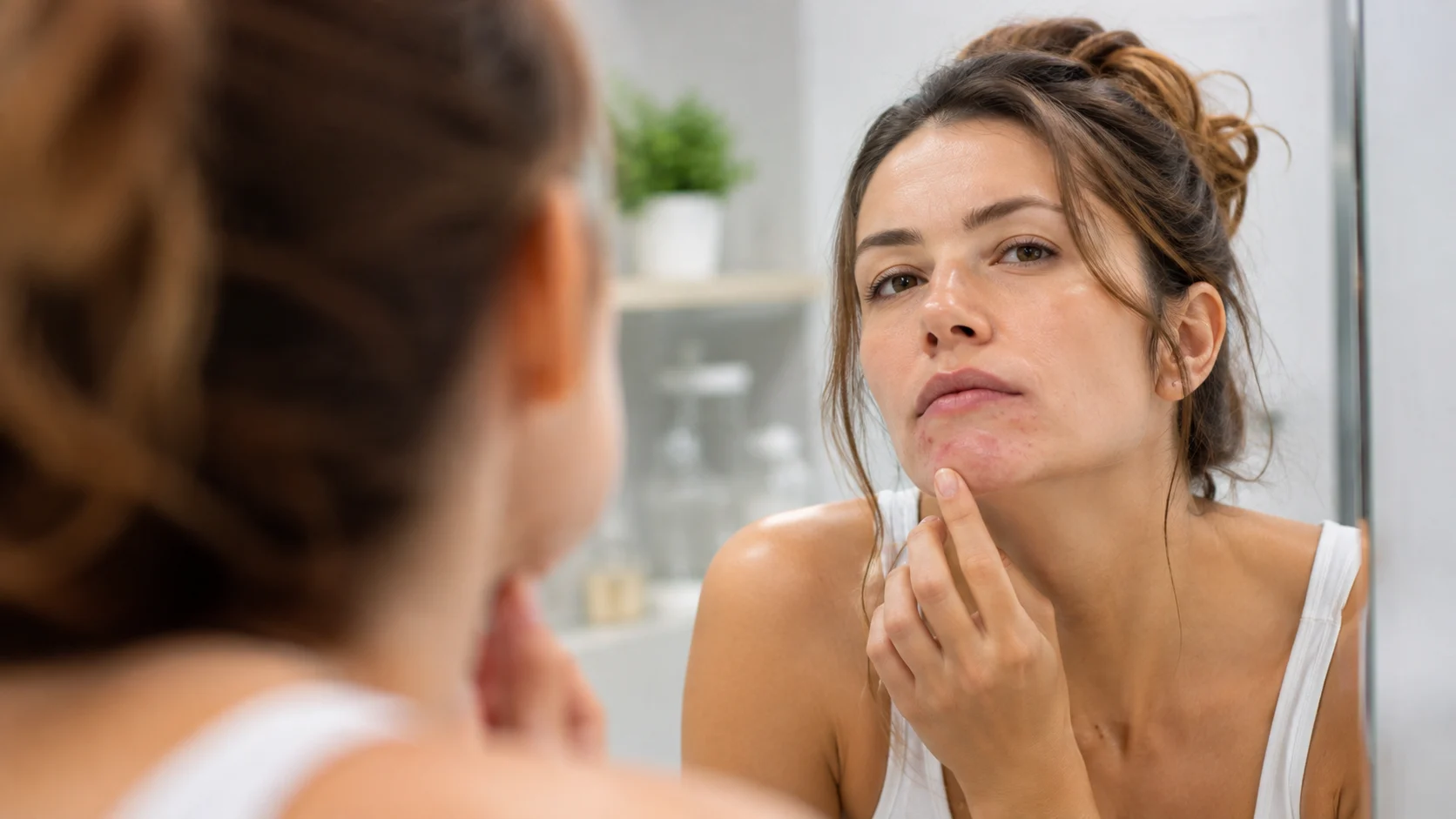
So why is your chin breaking out like you’re 16 again?
And why would your free testosterone tell a different story?
Sometimes the clue isn’t how much testosterone you make. It’s how much is available.
Her Total Testosterone Was Normal. So What Was Going On?
A normal total testosterone result doesn’t always tell us how much testosterone is unbound.
Recently, my daughter—four months postpartum and breastfeeding—started getting acne around her mouth.
Her bloodwork showed low estrogen and progesterone, normal total testosterone, elevated free testosterone, and SHBG near the lower end of normal.
As a mother, I wanted to know what was happening. As a nurse practitioner, I knew better than to assume one result explained everything.
Breastfeeding could explain her lower estrogen and progesterone. But the difference between total and free testosterone was worth understanding.
Could her hormone changes be contributing to her skin? Possibly. But that is not the same as proving the cause.
How Can Free Testosterone Be High When Total Testosterone Is Normal?
When SHBG is lower, a greater percentage of circulating testosterone may remain unbound.
Think of SHBG as a protein that carries and binds testosterone in your blood. Estrogen helps stimulate its production in the liver.
If estrogen falls, SHBG may fall too—but estrogen is only one influence. Thyroid health, insulin resistance, medications, and metabolic factors also matter.
That’s why a woman can have a normal total testosterone result but a higher free fraction.
And it’s why we look at the relationship between hormones, not just one number. Learn more about estrogen’s role in women’s health and testosterone in women.
One caution: some direct free testosterone tests are unreliable at the low concentrations typical in women. Unexpected results may need confirmation with more accurate testing.
Why Is It Showing Up on My Face?
Androgens can stimulate oil production and contribute to acne, particularly along the chin and jawline.
You might notice stubborn breakouts, oilier skin, new facial hair, or scalp hair changes.
But acne-like bumps clustered around the mouth can also be perioral dermatitis, which isn’t the same thing as hormonal acne.
Before blaming hormones—or buying another acne product—make sure you know what kind of skin condition you’re dealing with.
Does Breastfeeding Keep Estrogen and Progesterone Low?
Often, yes. Breastfeeding can suppress ovulation, leaving estrogen relatively low and progesterone low until ovulatory cycles resume.
After delivery, pregnancy-level estrogen and progesterone drop dramatically. For women who breastfeed, the return of normal cycles can take time.
So low values at four months postpartum may be a normal part of lactation—not a reason to start hormone replacement.
If you’ve ever wondered what progesterone actually does, explore our guide to progesterone for women.
What If I’m Not Postpartum—But My Skin Suddenly Changed?
Perimenopause can bring fluctuating estrogen levels and changes in skin and androgen activity, but it doesn’t automatically mean testosterone is high.
Maybe you haven’t had acne in 20 years.
Now you’re breaking out, your periods are changing, and your body doesn’t feel quite the same.
The transition can be confusing because hormone levels fluctuate rather than changing in a straight line.
For more context, read Perimenopause vs. Menopause.
Could Something Other Than Estrogen Be Raising My Free Testosterone?
Yes. Lower SHBG or increased androgen production can be associated with insulin resistance, PCOS, thyroid disorders, certain medications, and less common ovarian or adrenal conditions.
That doesn’t mean you have one of these conditions.
It means we shouldn’t decide that estrogen is the explanation before considering the rest of the picture.
Rapidly developing facial hair, voice deepening, or other marked signs of androgen excess deserve prompt medical assessment.
Which Hormone Tests Actually Help?
When androgen excess is suspected, accurate total testosterone testing, SHBG, and a reliable assessment of free testosterone can be useful starting points.
Depending on your symptoms and history, your clinician may consider thyroid testing, DHEA-S, metabolic markers, or other studies.
Estrogen and progesterone results need context, especially if you’re breastfeeding or still having menstrual cycles.
The goal isn’t to order every test. It’s to choose tests that answer a meaningful clinical question.
If you’re unsure where to start, our article Could My Symptoms Be Hormonal? walks through when an evaluation may help.
Should I Take Estrogen to Lower Free Testosterone?
Not automatically. Treatment depends on the cause, your symptoms, your health history, and whether you’re pregnant, postpartum, or breastfeeding.
For a breastfeeding woman, low estrogen can be expected, and estrogen-containing treatments may affect milk supply.
For other women, acne treatment or evaluation of an underlying condition may be more appropriate than hormone therapy.
We don’t treat a lab number in isolation. We treat the person—and only when treatment is warranted.
What If Your Skin Is Telling You Something?
A new symptom doesn’t automatically mean you have a hormone disorder. But it can be a reason to ask better questions.
My daughter’s experience was a reminder that the answer isn’t always sitting in the bolded number on a lab report.
Sometimes you have to look at how the pieces fit together.
At Revive Wellness & Beauty in Powell, Ohio, our provider-led approach considers symptoms, medical history, reproductive stage, and appropriate testing before recommending treatment.
Explore our Women’s Hormone Therapy and Evaluation page to learn more.
Wondering whether your symptoms could be hormonal? Start with a free 15-minute consultation.
Revive Wellness & Beauty | Powell, Ohio | Serving Dublin, Lewis Center and Greater Columbus
614-389-1968 | revivepowell.com
This article is educational and is not a diagnosis or a recommendation to start hormone treatment. Individual evaluation is especially important during pregnancy and breastfeeding.