
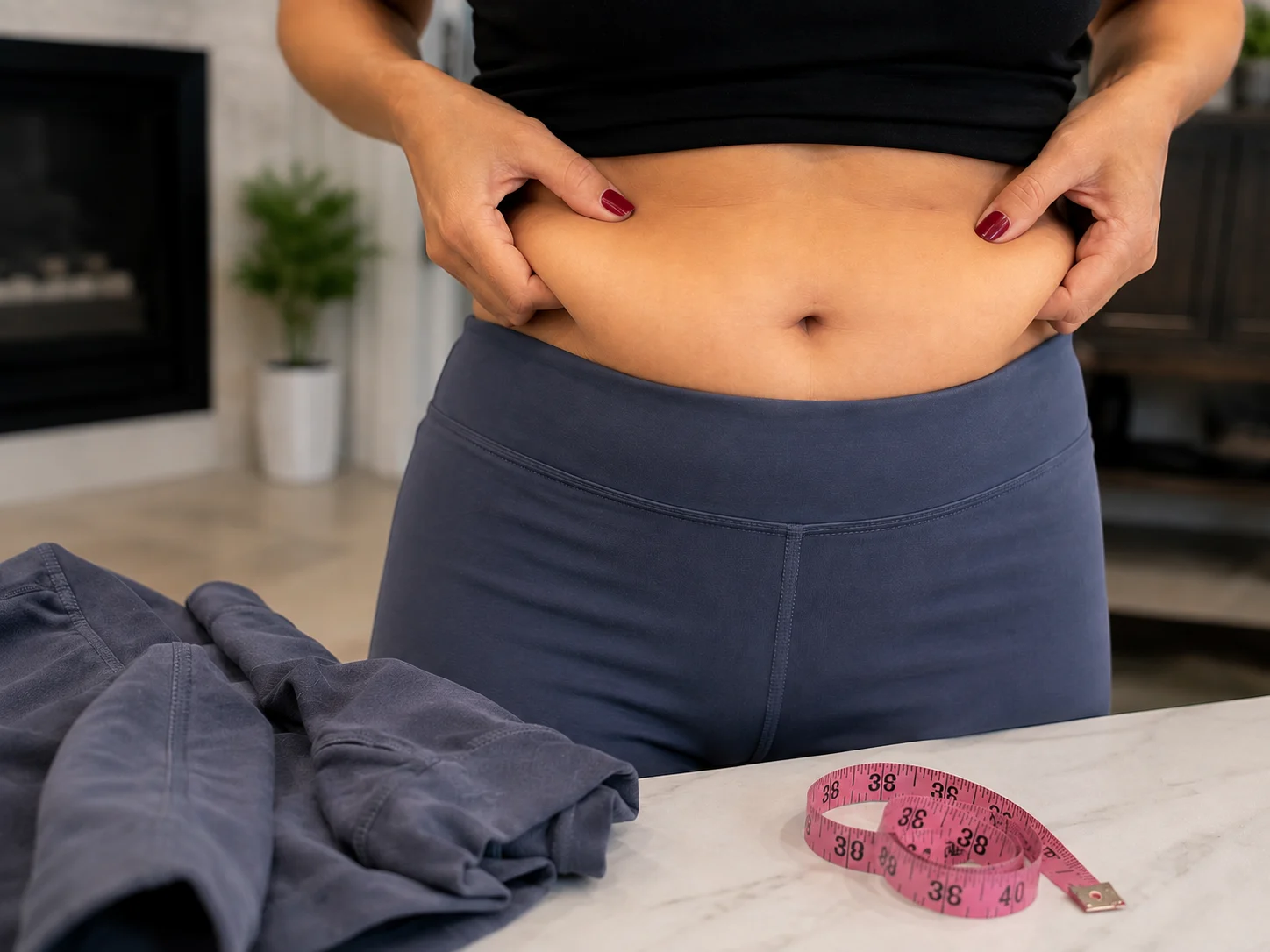
Same diet. Same workouts. Same number on the scale. So why is your stomach suddenly different?
Yes—perimenopause may be part of the reason. Hormonal changes can shift where your body stores fat, especially around your abdomen, while changes in muscle, sleep and metabolism can make it even more noticeable.
And here’s the part that catches a lot of women off guard:
You don’t even have to gain much weight for your waistline to change.
Your jeans are tighter.
Your stomach looks different.
And you’re standing in front of the mirror thinking:
“Seriously…where did THIS come from?”
Before you cut more calories, add another cardio class or decide your metabolism has completely given up on you, let’s look at what’s actually happening.
Because this isn’t just about the number on the scale.
Your body composition may be changing.
But I Haven’t Gained Weight!
And you may be absolutely right.
You can weigh exactly what you weighed last year and still have a very different body.
During the menopause transition, changes in body composition and where fat is stored can change your shape—even when the scale barely moves.
So the scale might say:
“Nothing to see here.”
Meanwhile, your jeans are telling a completely different story.
That’s why I care about more than your weight.
How much muscle do you have?
Has your body-fat percentage changed?
Has your waist measurement changed?
This is one reason we use 3D body composition measurements at Revive. The scale gives us one number. It doesn’t tell us the whole story.
Sometimes the goal isn’t simply to lose pounds.
It’s to change what those pounds are made of.
Okay…So How Do I Get Rid of Perimenopause Belly Fat?
You can reduce belly fat—but doing more cardio and eating less isn’t necessarily the answer.
If what worked at 35 isn’t working at 45, doing more and more of the same thing may not be the best strategy.
Protect Your Muscle
Muscle matters—a lot.
Maintaining muscle becomes harder as we age, which is why strength training and adequate protein become increasingly important.
I don’t want the entire focus to be on making the number on the scale smaller while you’re also losing the muscle we want you to keep.
Stop Ignoring Your Sleep
If you’re waking up at 2 or 3 AM, throwing off the covers, putting them back on and starting your day exhausted…
I care about that.
Poor sleep can affect hunger, cravings, activity and metabolic health.
So sometimes my first question isn’t:
“What diet are you on?”
It’s:
“Are you actually sleeping?”
Look at What You’re Eating—Not Just How Much
I don’t want you surviving on coffee until noon and then wondering why you’re starving at 4 PM.
Protein, fiber, whole foods and adequate nutrition matter.
Sometimes eating less isn’t the answer. Eating differently is.
Will HRT Get Rid of My Belly Fat?
No—HRT is not a weight-loss treatment, and I wouldn’t prescribe hormones just to get rid of belly fat.
But if you’re also dealing with hot flashes, night sweats, poor sleep, vaginal changes or other symptoms of perimenopause, hormone therapy may be something we discuss for those symptoms.
If you’re finally sleeping, you may have more energy to move.
You may feel more like yourself.
Getting back to strength training may not feel impossible.
That’s very different from saying estrogen melts belly fat. It doesn’t.
So if belly fat is your only symptom, I’m not jumping straight to hormones.
But if your changing waistline showed up with a whole list of other changes?
Now I want to hear about those too.
Not sure whether what you’re experiencing could be hormonal? Read Could My Symptoms Be Hormonal?.
Is Belly Fat Just a Cosmetic Issue?
No—and this is the part I really want women to understand.
The fat we carry deeper in the abdomen, called visceral fat, is different from the fat you can pinch under your skin.
Higher amounts of visceral fat are associated with metabolic and cardiovascular health risks, including insulin resistance and type 2 diabetes.
So yes, I want you to feel good in your jeans.
But I care a lot more about what’s happening on the inside.
A changing waistline can be a reason to pay attention to the bigger picture—not panic, just pay attention.
What If I’m Doing Everything Right and It Still Isn’t Working?
That’s when it may be time to stop guessing.
If you’re eating well, working on strength training and still struggling, we can look at your health history, symptoms, medications, sleep, metabolic health and whether additional testing makes sense.
At Revive, our Medical Weight Loss program looks beyond the number on the scale.
For some patients, medically supervised treatment with semaglutide or tirzepatide may be appropriate. For others, medication may not be the first step at all.
And if you’re already using a GLP-1, protecting muscle and getting adequate nutrition become especially important.
You can read more in Why Am I Losing Hair on Semaglutide?.
If you’re also noticing symptoms that make you wonder about hormones, learn more about our Women’s Hormone Therapy.
Sometimes it’s weight. Sometimes it’s hormones. Sometimes it’s metabolic health. And sometimes several things are happening at once.
That’s why we look at you instead of assuming we already know the answer.
Frequently Asked Questions
Is Perimenopause Belly Fat Visceral Fat?
Not necessarily.
Belly fat can include both subcutaneous fat—the fat just beneath your skin—and visceral fat, which is stored deeper in the abdomen around your organs.
You can’t tell exactly how much visceral fat you have simply by looking at your stomach.
At What Age Does Perimenopause Belly Fat Usually Start?
There isn’t one specific age.
Perimenopause commonly begins in the 40s, but every woman is different.
Changes in your waistline may happen around the same time you’re noticing changes in your periods, sleep, hot flashes or other symptoms—but a changing waistline alone doesn’t tell us that perimenopause is the cause.
Should I Have Blood Work If I’m Gaining Belly Fat During Perimenopause?
Not everyone needs extensive blood work just because their waistline changes.
But if the change is unexplained or you’re also dealing with fatigue, sleep changes, irregular periods, hot flashes or other symptoms, an evaluation can help us decide whether testing makes sense.
The goal isn’t to order every lab possible.
It’s to order the right testing when there’s a reason to look deeper.
Ready to Figure Out What’s Going On?
If you’re doing all the things you used to do and your body suddenly isn’t responding the same way, you don’t have to keep guessing.
Start with a 15-minute complimentary consultation at Revive Wellness & Beauty.
Tell us what’s changing, what you’ve tried and what you’re struggling with.
Then we’ll help you determine the right next step—whether that’s body-composition evaluation, lab testing, hormone evaluation, medical weight loss or simply a different approach.
Because “just eat less” isn’t always the answer.
And neither is blaming everything on your hormones.
Let’s figure out what’s actually going on.