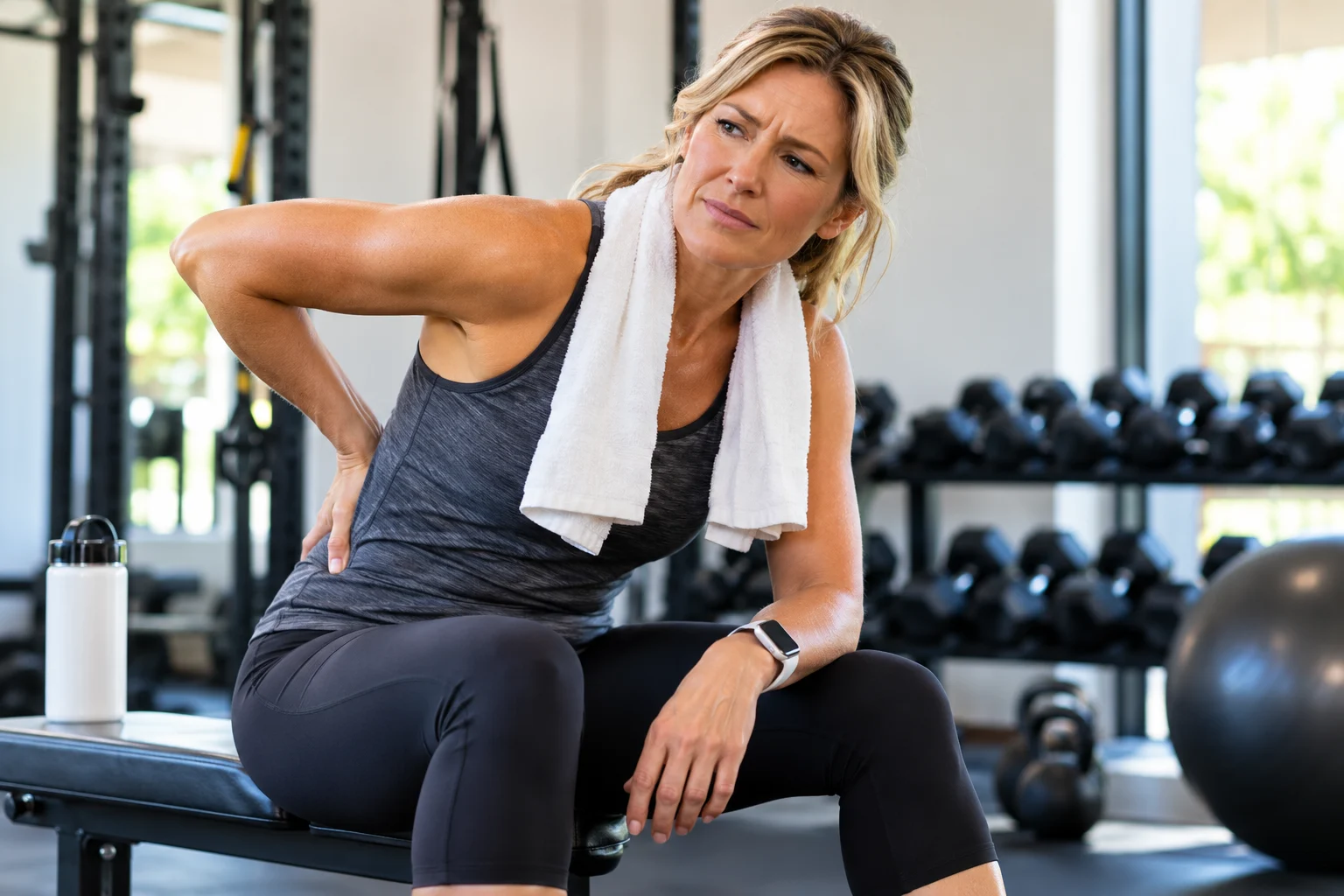
Your body may feel stiffer, achier and slower to recover after 40 because several things can start changing at the same time: you may gradually lose muscle and strength, your joints have years of accumulated stress, recovery may take longer, sleep can affect how you experience pain, body composition can change, and hormonal changes can affect both women and men.
In other words, you didn’t wake up one morning and suddenly become “old.”
But it can certainly feel that way.
You get out of bed and those first few steps are…rough.
You stand up after sitting through a meeting and need a second before you start walking.
You turn your head and wonder what you did to your neck.
You work out on Monday and your legs are still discussing it on Wednesday.
You drop something on the floor and seriously consider whether you really need it back.
And suddenly you’re making noises when you get off the couch.
Sound familiar?
The frustrating part is that you may not have changed anything.
Same weight.
Same job.
Maybe even the same workout.
So why does your body feel so different?
Usually, it’s not one thing.
Same Weight. Different Body.
This is one of the biggest midlife surprises.
You step on the scale.
175.
That’s about what you weighed ten years ago.
So why do your clothes fit differently? Why do you feel weaker? Why does getting off the floor suddenly require a strategy?
Because 175 pounds doesn’t tell us what those 175 pounds are made of.
You can lose muscle and gain body fat while the scale barely moves.
And muscle matters—a lot.
Muscle helps support your joints, stabilize your body, maintain strength and handle the physical demands you put on yourself every day.
Think about climbing stairs.
Carrying groceries.
Playing golf.
Picking up your grandchild.
Working in the yard.
Getting through a workout.
You need muscle for all of it.
The National Institute on Aging explains how age-related changes in muscle can affect strength and physical function—which is one reason maintaining muscle becomes increasingly important as we get older.
So maybe the better question isn’t:
“How much do I weigh?”
It’s:
“How much muscle am I carrying?”
That’s something your bathroom scale can’t answer.
At Revive, a 3D Body Composition Scan can help us look beyond weight and follow changes in lean mass, body fat and measurements over time.
Remember That Knee You Injured Years Ago?
It remembers you too.
Your joints have history.
Sports.
Running.
Physical jobs.
Sitting at a computer for 20 years.
Old injuries.
Weekend projects.
Thousands of workouts.
Thousands more hours sitting.
Your body has been keeping receipts.
That doesn’t mean you’re falling apart.
But previous injuries, repetitive movements and changes in joints and connective tissues can become more noticeable with age.
Sometimes your body isn’t saying:
“Stop moving.”
It’s saying:
“Could we please start doing this a little smarter?”
Why Does One Workout Now Require a Recovery Plan?
This one feels unfair.
At 25:
Workout. Shower. Dinner. Done.
At 45:
Workout. Shower. Protein. Water. Stretch. Sleep. Wake up.
Still sore.
Your body has to repair and adapt after exercise, and recovery depends on more than age.
Are you eating enough protein?
Are you hydrated?
Are you sleeping?
Are you strength training consistently—or sitting all week and then trying to become an Olympic athlete on Saturday?
Are you giving your body enough time to recover?
Sometimes people think they need a harder workout.
What they actually need may be better recovery.
And Then There’s Sleep…
This may be the sneaky one.
You sleep badly.
You wake up tired.
You don’t feel like exercising.
You sit more.
You’re stiff.
You hurt.
Then the discomfort makes it harder to sleep.
Congratulations—you’ve entered the world’s least enjoyable circle.
Poor sleep can interfere with recovery and can affect how strongly we experience pain.
So when someone says:
“I’m exhausted, I’m sore, and I don’t recover anymore.”
Those may not be three completely separate problems.
What About Hormones?
They can matter.
And this isn’t just a women’s issue.
For women, perimenopause and menopause involve changes in estrogen and other hormones. Those changes have effects beyond periods and hot flashes, including effects on bone and musculoskeletal health.
The Menopause Society includes joint aches and pains among symptoms that can occur around the menopause transition.
For men, testosterone plays an important role in maintaining muscle and bone, and testosterone levels can change with age.
But we’re not going to blame every sore shoulder on hormones.
Achy joints don’t automatically mean a woman needs estrogen.
Fatigue or loss of strength doesn’t automatically mean a man has low testosterone.
But if you’re noticing several changes at once—less strength, poor recovery, sleep changes, fatigue, body-composition changes, sexual changes or simply feeling noticeably different—it may be worth looking at the bigger picture.
So…Do I Just Accept This Now?
No.
Getting older is inevitable.
Getting weaker without doing anything about it isn’t.
There are things you can influence.
Build muscle.
Eat enough protein.
Move every day.
Strength train.
Hydrate.
Sleep.
Recover.
Know your body composition.
And stop judging your health entirely by the number between your feet on a bathroom scale.
But that brings us to the next question:
What if you’re already trying—and you still don’t feel good?
Okay…How Do I Start Feeling Better?
This is where we stop blaming age and start asking what your body may actually need.
And no—you don’t necessarily need another supplement, another diet or another workout program.
You need to figure out what’s missing.
Are You Actually Getting Enough Protein?
“I eat pretty healthy” doesn’t necessarily mean you’re eating enough protein to support your goals.
Protein provides amino acids your body uses to build and maintain muscle.
And if maintaining strength and muscle is part of the goal, that matters.
This becomes especially important when you’re actively losing weight.
We don’t just want weight loss.
We want to preserve as much muscle as possible while improving body composition.
That’s why we look at more than the number on the scale.
What About Vitamins and Nutrients?
This is another area where guessing isn’t particularly helpful.
Fatigue, weakness, poor recovery and simply feeling “off” can sometimes overlap with nutritional deficiencies or other medical issues.
Depending on your symptoms, health history and goals, it may make sense to evaluate things such as:
Vitamin D
Vitamin B12 and folate
Iron and ferritin
Thyroid function
Blood counts
Metabolic health
And, when appropriate, hormones.
The answer isn’t to buy ten supplements because someone on social media said everyone over 40 needs them.
Test when it makes sense.
Identify what actually needs attention.
Then build the plan from there.
At Revive, we can use targeted laboratory testing and a clinical evaluation to help determine whether there are areas that deserve a closer look.
Could Vitamin Injections Help?
For some people, vitamin or nutrient injections may be one tool in a larger wellness plan when clinically appropriate.
At Revive, we offer Vitamin & Wellness Injections, including options such as Vitamin B12, B-complex, Vitamin D and other nutrients.
But more isn’t automatically better.
If you’re deficient in something, that’s useful information.
If you’re not, taking more of it isn’t necessarily going to solve why you feel tired, sore or run down.
The goal is the right support for the right person.
What About IV Therapy?
Sometimes hydration and recovery need attention too.
IV Therapy at Revive can provide fluids along with selected vitamins, minerals or other ingredients depending on the formulation and what’s clinically appropriate for you.
But an IV doesn’t replace drinking water.
It doesn’t replace protein.
It doesn’t replace sleep.
And it definitely doesn’t replace taking care of yourself the other six days of the week.
Think of it as another possible tool—not the entire toolbox.
Are You Maintaining Muscle—or Losing It?
This is where we stop guessing.
Your traditional scale can’t tell you whether you’re losing fat, losing muscle or changing both.
Our 3D Body Composition Scan gives us another way to follow changes over time.
If you’re losing weight but also losing significant muscle?
We want to know.
If your scale hasn’t moved much but you’re maintaining or gaining lean mass while losing inches?
We want to know that too.
Because your goal shouldn’t simply be to become a smaller number.
It should include becoming stronger and protecting the body you’re going to need for the next several decades.
What If Recovery Is My Biggest Problem?
Maybe you’re eating well.
Maybe you’re exercising.
Maybe your labs don’t reveal an obvious explanation.
You just don’t bounce back like you used to.
That’s where recovery-focused wellness services may fit.
Red Light Therapy can be incorporated into a broader wellness and recovery routine.
Whole-Body Cryotherapy is another recovery option available at Revive.
We also offer vibration plate sessions that can complement movement and wellness goals.
None of these replaces strength training, sleep, hydration or good nutrition.
They’re tools we can use alongside the fundamentals.
And What If It Is Hormonal?
Then we want to know that too.
For women, changes in periods, hot flashes, night sweats, sleep, sexual health, energy or body composition may be reasons to discuss perimenopause or menopause.
You can learn more about Women’s Hormone Therapy at Revive and how we approach symptoms and treatment options.
For men, changes in energy, strength, muscle, sexual function and other symptoms may warrant a broader evaluation that can include testosterone when clinically appropriate.
Our Hormone Replacement Therapy program begins with evaluation rather than assuming hormones are the answer.
The goal isn’t to put everyone over 40 on hormones.
The goal is to stop guessing.
This Is What Wellness Should Actually Mean
Wellness isn’t doing every treatment on the menu.
It’s figuring out:
What is changing?
What is your body missing?
What can we measure?
What can we improve?
For one person, the answer may be more protein, strength training and better sleep.
For another, testing may uncover low Vitamin D, B12, iron or another issue that needs attention.
Someone losing weight may need to focus more on preserving muscle.
Someone else may have symptoms that warrant a hormone evaluation.
And another person may simply need a better recovery routine.
You don’t need everything.
You need the right tools for your body and your goals.
When Should I Stop Blaming My Age?
When something doesn’t feel right.
Being 42, 48 or 55 doesn’t mean every new pain is “normal.”
Severe, persistent or worsening pain deserves medical evaluation.
So does significant swelling, redness or warmth around a joint, unexplained weakness, persistent numbness or tingling, fever, an injury that isn’t improving, or pain that’s interfering with your everyday activities.
And if you suddenly feel dramatically different than you did six months ago, pay attention to that too.
“I’m over 40” isn’t a diagnosis.
Frequently Asked Questions
How much protein do adults over 40 need?
A practical target for many healthy adults over 40 who want to maintain or build muscle is about 1.2–1.6 grams of protein per kilogram of body weight per day, particularly when combined with resistance training.
For a 150-pound adult, that’s roughly 82–109 grams of protein per day. For a 180-pound adult, it’s about 98–131 grams per day.
Spreading protein throughout the day rather than eating most of it at one meal may also help support muscle protein synthesis.
Your individual needs can vary based on your body size, activity level, weight-loss goals and health history. People with kidney disease or certain medical conditions should discuss their protein intake with their healthcare provider.
How often should adults over 40 strength train?
For general health, adults should include muscle-strengthening activity at least two days per week, working the major muscle groups.
But simply doing the same exercises with the same weights forever isn’t necessarily enough if your goal is to build strength or muscle.
Your muscles need an appropriate challenge. Depending on your fitness level, that may mean gradually increasing resistance, repetitions or the difficulty of the exercise over time.
You also don’t need to spend every day in the gym.
Consistency matters more than trying to make every workout extreme.
If you’re new to strength training, have an injury or have a medical condition that affects exercise, get appropriate guidance before beginning a new program.
How can I tell if I’m losing muscle as I get older?
Sometimes you can see it. Other times, the first clues are things you notice in everyday life.
Maybe the grocery bags feel heavier.
Getting up from the floor is harder.
You can’t lift what you used to at the gym.
Your arms or legs look smaller or less defined.
Or your weight hasn’t changed much, but you feel weaker.
Strength and function matter just as much as appearance.
Tracking your strength, measurements and body composition over time can give you more useful information than watching body weight alone.
At Revive, our 3D Body Composition Scan can help follow changes in lean mass, body fat and measurements over time.
Why am I losing muscle while I’m losing weight?
Because when you lose weight, your body doesn’t automatically lose only body fat.
Some lean tissue can be lost during weight loss too, particularly when calorie intake is very low, protein intake is inadequate or resistance training isn’t part of the plan.
That’s why the goal shouldn’t simply be:
“Lose as much weight as possible.”
It should also include protecting muscle while you’re doing it.
Adequate protein, resistance training, appropriate nutrition and monitoring body composition can all become important during weight loss.
The scale tells you how much weight you lost. It doesn’t tell you what you lost.
Is walking enough exercise after 40?
Walking is excellent exercise and can support cardiovascular health, mobility and overall activity.
But walking and strength training do different things.
If your goal is to maintain muscle and strength as you age, walking alone may not provide enough resistance to challenge all of your major muscle groups.
You don’t have to choose between walking and lifting weights.
A well-rounded routine can include walking or other aerobic activity along with regular resistance training, balance work and mobility.
How do I know if soreness after exercise is normal?
Mild muscle soreness that develops after a new or more challenging workout can be normal and may be most noticeable over the next day or two.
But not every pain after exercise should be dismissed as normal soreness.
Sharp pain, significant swelling, redness, warmth, severe weakness, inability to use the affected area normally, or pain that continues to worsen deserves more attention.
Muscle soreness after a workout and an injury are not the same thing.
If you’re unsure which one you’re experiencing—or pain is persistent or interfering with normal activity—it’s appropriate to have it evaluated.
What Do You Want Your Body to Be Able to Do at 60?
Forget trying to get your 25-year-old body back.
Ask a better question:
What do you want your body to be able to do 10, 20 or 30 years from now?
Travel?
Golf?
Hike?
Play with your grandchildren?
Lift your own suitcase?
Get down on the floor—and back up again?
Keep doing the workouts you love?
That’s the body we’re interested in.
And what you do in your 40s and 50s can help build it.
Build muscle.
Protect it.
Eat well.
Sleep.
Move.
Recover.
Know what’s happening inside your body—not just what the scale says.
And when something changes, get curious about why.
At Revive, that’s where we can help: look at the bigger picture, identify what may need attention, and help you build a wellness plan around where you are now and where you want to go.
The goal isn’t to feel 25 again.
It’s to keep feeling capable in the body you’re building.