
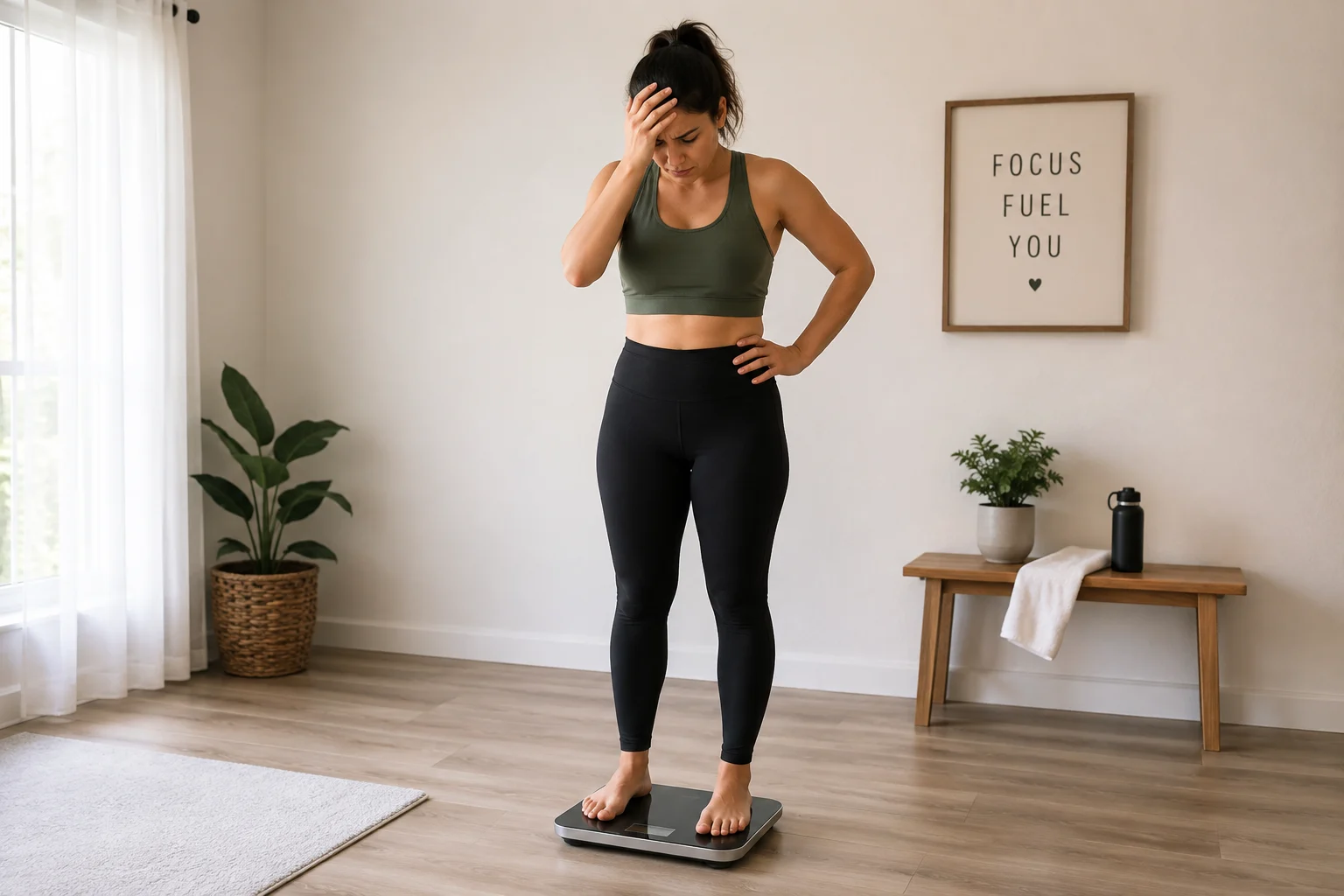
Why Am I Not Losing Weight on My GLP-1?
You started semaglutide or tirzepatide expecting the scale to move. Maybe it did at first. Now it has slowed—or stopped. Does that mean your GLP-1 stopped working?
Why am I not losing weight on my GLP-1?
A slowdown does not automatically mean semaglutide or tirzepatide has stopped working. Dose and time on treatment, individual response, medication adherence, nutrition, activity, sleep, other medications or medical conditions, and changes in body composition can all affect what you see on the scale.
And here is the part many people miss:
“I never really started losing” and “I lost weight and then plateaued” are not the same situation.
Before automatically increasing a dose, switching medications, or deciding the treatment failed, it helps to understand which situation you are actually in.
At Revive Wellness & Beauty’s medical weight loss program in Powell, Ohio, we look beyond a single number on the scale. We review the medication, dose, timeline, symptoms, nutrition, activity, side effects, health history, and Fit3D body scan trends together.
Because sometimes the scale is telling you something important—and sometimes it is only telling you part of the story.
________
Did You Never Start Losing—or Did You Stop Losing?
This is one of the first questions worth answering.
If you recently started treatment, you may still be early in dose escalation. FDA-approved Wegovy and Zepbound both begin at lower doses and use gradual escalation schedules rather than starting at their maintenance doses. The current prescribing information also directs clinicians to consider treatment response and tolerability when selecting maintenance dosing. Review current Wegovy prescribing information. Review current Zepbound prescribing information.
That means an early response should not automatically be compared with someone who has been on treatment much longer.
A plateau after meaningful prior weight loss is different.
In the STEP 1 semaglutide trial, average weight loss developed over many months and the group-level curve gradually flattened rather than continuing downward in a straight line indefinitely. Read the STEP 1 semaglutide trial on PubMed.
The question is not simply, “Did the scale move this week?”
It is:
How long have you been on treatment?
What dose and formulation are you actually taking?
What was your previous response?
How long has the slowdown lasted?
What else changed around the same time?
Those answers provide far more context than a single weigh-in.
________
Does a Plateau Mean My GLP-1 Stopped Working?
Not necessarily.
Weight loss is not expected to continue at the same rate forever.
As body weight decreases, energy requirements also change. Research on weight loss shows reductions in energy expenditure and metabolic adaptations that can make continued weight loss more difficult over time. Read the review of energy metabolism during weight loss on PubMed. Weight-loss trajectories in clinical trials also tend to slow over time.
A plateau can be a reason to reassess the plan—but it is not proof that the medication has suddenly become ineffective.
That is why we do not recommend automatically chasing a higher dose simply because the scale slows.
FDA-approved Wegovy and Zepbound labeling uses stepwise dose escalation and emphasizes treatment response and tolerability in maintenance-dose selection. See Wegovy prescribing information. See Zepbound prescribing information.
The goal is not the highest dose. The goal is an appropriate plan for you.
________
What If My Hunger or “Food Noise” Is Coming Back?
Returning hunger deserves a review, but hunger alone does not prove your medication has stopped working.
GLP-1-based medications influence appetite and satiety, but treatment response varies between people and across time.
A provider may want to review your current medication and dose, how consistently you are taking it, how long you have been at that dose, your weight trajectory, side effects, food intake, activity, and whether another medical or medication-related factor may be contributing.
Do not use someone else’s hunger level—or someone else’s dose—as the benchmark for your own treatment.
If you are taking semaglutide, learn more about our provider-led semaglutide program. If you are taking tirzepatide, explore our tirzepatide weight loss program.
________
Could I Be Making Progress Even If the Scale Is Stuck?
Yes. The scale measures total body weight. It does not tell you exactly what changed underneath that number.
Weight change can include changes in fat mass, lean mass, body water, and other tissues. Recent reviews of GLP-1-based obesity treatment emphasize that body weight alone cannot describe the quality of weight loss and support monitoring body composition and physical function alongside weight when clinically useful. Read the 2026 review on weight-loss quality, nutrition, and resistance training.
That is one reason we use Fit3D at Revive.
Fit3D creates a 360-degree body model and provides circumference and body-shape measurements, posture information, and body-composition estimates that can be compared over time. Research evaluating commercial 3D optical scanners, including Fit3D, found high test-retest precision for circumference and volume estimates. Read the 3D optical scanning validation study on PubMed.
Fit3D does not make the scale irrelevant. It gives us another way to look at the trend.
We can compare weight with waist and other circumference changes, body-shape changes, and estimated body-composition trends rather than deciding that one unmoving number means nothing is happening.
Body-composition values from 3D scanning are estimates, not the same as direct tissue measurement or DXA, so we interpret them as one part of the overall clinical picture.
________
Are You Losing Fat—and Protecting Lean Mass?
How you lose weight matters, not just how many pounds you lose.
A 2026 systematic review and meta-analysis of 20 randomized trials involving 15,782 participants found that lean mass represented a portion of total weight lost with incretin-based therapies. The same analysis found a more favorable lean-mass profile in lifestyle interventions that included resistance training. Read the 2026 lean-mass meta-analysis on PubMed.
A separate 2026 review concluded that a practical supportive approach during GLP-1-based treatment includes adequate protein intake, structured resistance exercise, management of gastrointestinal side effects, and monitoring when appropriate. Read the GLP-1 muscle-preservation review on PubMed.
This does not mean every pound of lean-mass change equals skeletal muscle loss, and it does not mean GLP-1 medications inevitably cause loss of strength. Lean mass is a broader measurement than muscle alone.
It does mean that a medical weight-loss plan should care about more than making the scale fall as fast as possible.
At Revive, we look at nutrition, resistance activity, Fit3D trends, symptoms, medication response, and overall progress together.
________
Could I Be Eating Too Little—or Missing the Nutrition That Matters?
Eating less is not automatically the same as eating well.
GLP-1-based medications can substantially reduce appetite. If intake becomes very low, it can become harder to consume adequate protein, micronutrients, fluids, and overall nutrition.
Recent reviews focused on GLP-1 obesity treatment recommend attention to dietary adequacy, protein intake, gastrointestinal tolerance, and resistance exercise rather than relying on medication alone. Read the 2026 nutrition and muscle-preservation review.
That does not mean there is one universal protein target or diet that is right for every person.
It means that if weight loss slows—or if you are losing weight rapidly while feeling weak, struggling to eat, or experiencing persistent gastrointestinal symptoms—your nutrition deserves a closer look.
________
What Else Can Affect Weight-Loss Progress?
A GLP-1 is only one part of the picture.
When progress changes, a clinician may review factors such as:
• How long you have been taking the medication and your current prescribed dose
• Missed doses, interruptions, or changes in how the medication has been used
• Nutrition and overall energy intake
• Protein intake and resistance activity
• Sleep and daily activity
• Side effects that are affecting food or fluid intake
• Other medications that may influence weight
• Medical conditions that may affect weight or appetite
• Menopause-related changes in body composition, sleep, activity, or symptoms
• Whether your goals and maintenance strategy need to evolve
If menopause is part of your story, read Weight Loss After Menopause: Why It’s Different.
The point is not to assume that hormones, cortisol, or another hidden problem is always responsible for a plateau.
The point is to stop guessing and review the whole picture.
________
What If I Use a Compounded GLP-1?
Know the exact medication, concentration, prescribed dose, and instructions you were given.
Compounded products can differ from FDA-approved prefilled products. FDA has warned that compounded injectable semaglutide may be supplied in different concentrations and containers, and that confusion between milligrams, milliliters, and syringe “units” has contributed to dosing errors. FDA has also reported concerns involving compounded semaglutide and tirzepatide prescribed outside FDA-approved dosing schedules. Read the FDA compounded semaglutide dosing alert. Read FDA’s current concerns about unapproved GLP-1 products.
Do not compare the number of syringe units you use with someone else’s injection unless you know the medications and concentrations are identical.
And do not recalculate or increase a compounded dose on your own.
________
Should I Switch From Semaglutide to Tirzepatide?
Maybe—but a plateau by itself does not tell us that you should switch.
In the 2025 SURMOUNT-5 trial, adults with obesity without diabetes who received tirzepatide lost more weight on average over 72 weeks than those who received semaglutide: 20.2% versus 13.7% mean weight reduction. Read the SURMOUNT-5 trial on PubMed.
That is useful comparative evidence.
It does not mean tirzepatide is automatically the right answer for every person whose semaglutide progress has slowed.
Medication selection still depends on your health history, previous response, side effects, tolerability, goals, contraindications, access, and provider assessment.
For a deeper comparison, read our Semaglutide vs. Tirzepatide guide.
________
What Should You NOT Do When Weight Loss Slows?
Do not let frustration turn into self-directed medication changes.
Avoid:
• Automatically increasing your dose
• Taking medication more frequently than prescribed
• Comparing syringe “units” without comparing medication concentration
• Drastically cutting food intake just to force the scale down
• Switching medications because a friend lost more weight
• Ignoring persistent side effects
• Judging your entire progress by one number on the scale
• Waiting until goal weight to think about maintenance
The FDA has specifically warned about adverse events associated with dosing errors and overly rapid or excessive dosing of compounded GLP-1 products. Read the FDA safety information.
A plateau is a reason to review your plan—not experiment with it.
________
What Happens When I Reach My Goal—or If I Eventually Stop?
Maintenance should not be an afterthought.
In the STEP 1 extension, participants who had received semaglutide regained about two-thirds of their prior weight loss during the year after treatment was withdrawn. Read the STEP 1 extension on PubMed.
That does not mean every person will regain the same amount.
It does show why long-term planning matters.
Your plan may include ongoing medical follow-up, nutrition and resistance exercise, body-composition monitoring, behavioral strategies, medication when clinically appropriate, and an individualized transition or maintenance strategy.
Learn more about Revive’s Weight Loss Maintenance Plans.
________
What Makes Revive’s Approach Different When You Feel Stuck?
We do not want to answer every plateau with “increase the dose.”
At Revive, a plateau review may include your:
• Weight trajectory—not just today’s weight
• Medication, formulation, prescribed dose, and time on treatment
• Side effects and tolerability
• Hunger and eating patterns
• Nutrition and protein intake
• Activity and resistance exercise
• Fit3D measurements and body-composition estimates
• Sleep, symptoms, other medications, and medical history
• Goals and long-term maintenance plan
Our medical weight loss programs include provider-led oversight and body-composition tracking because medication is a tool—not the entire plan.
Sometimes the answer is an adjustment.
Sometimes it is a different treatment.
And sometimes it is staying the course.
The important part is knowing why.
________
Frequently Asked Questions
Why am I not losing weight on semaglutide?
There is no single explanation. Time on treatment, dose, individual response, medication adherence, nutrition, activity, other medications or medical conditions, and body-composition changes can all provide important context. A provider can review the pattern before deciding whether treatment should change.
Why am I not losing weight on tirzepatide?
Tirzepatide response varies between individuals. If progress is limited or has slowed, your provider can review treatment duration, dose, adherence, nutrition, activity, side effects, health factors, and your overall weight and body-composition trend.
Does a GLP-1 plateau mean the medication stopped working?
Not necessarily. Clinical-trial weight-loss curves slow over time, and a plateau does not by itself prove medication failure. It is a reason to reassess the full treatment plan.
What if my hunger comes back on a GLP-1?
Returning hunger is worth discussing with your provider, but hunger alone does not prove the medication stopped working. Your medication, dose, duration, adherence, weight trajectory, nutrition, and other health factors should be reviewed together.
Should I increase my GLP-1 dose if my weight loss stops?
Do not increase medication on your own. FDA-approved GLP-1 obesity medications use specific escalation schedules, and dose selection should consider response and tolerability. Compounded products may also vary in concentration, making self-directed dose changes particularly risky.
Can I switch from semaglutide to tirzepatide?
A provider may consider a switch in some circumstances. SURMOUNT-5 found greater average weight reduction with tirzepatide than semaglutide in adults with obesity without diabetes, but that does not make switching the correct choice for every individual.
Can I be losing inches even if the scale is not moving?
Yes. Scale weight does not show body shape or circumference changes. Fit3D can track circumference, body-shape, posture, and estimated body-composition trends over time, which can add context to scale weight.
Does GLP-1 weight loss cause muscle loss?
Weight loss can include some lean-mass loss, but lean mass is not identical to skeletal muscle. Current reviews support adequate nutrition, resistance exercise, and appropriate monitoring to help preserve lean tissue and function during substantial weight loss.
Can menopause affect my weight-loss journey?
Menopause can be associated with changes in body composition and other factors such as sleep and activity that may affect weight management. It should be considered as part of the overall clinical picture rather than assumed to be the sole cause of a plateau.
Will I regain weight if I stop semaglutide?
Weight regain can occur. In the STEP 1 extension, participants regained about two-thirds of their prior weight loss during the year after semaglutide withdrawal. Individual outcomes vary, which is why maintenance planning matters.
________
Medical References
Most J, Redman LM. Impact of calorie restriction on energy metabolism in humans. Experimental Gerontology. 2020;133:110875. Read the energy-metabolism review on PubMed.
Wilding JPH, Batterham RL, Calanna S, et al. Once-Weekly Semaglutide in Adults with Overweight or Obesity. New England Journal of Medicine. 2021;384:989–1002. Read STEP 1 on PubMed.
Wilding JPH, Batterham RL, Davies M, et al. Weight regain and cardiometabolic effects after withdrawal of semaglutide: The STEP 1 trial extension. Diabetes, Obesity and Metabolism. 2022;24(8):1553–1564. Read the STEP 1 extension on PubMed.
Aronne LJ, Bade Horn D, le Roux CW, et al. Tirzepatide as Compared with Semaglutide for the Treatment of Obesity. New England Journal of Medicine. 2025;393:26–36. Read SURMOUNT-5 on PubMed.
Eisa N, Barood O. Lean Mass Changes With Incretin Therapy Versus Lifestyle Intervention: A Systematic Review and Meta-Analysis of Randomised Controlled Trials. Diabetes, Obesity and Metabolism. 2026. Read the meta-analysis on PubMed.
Šantić R, et al. Lean Mass and Musculoskeletal Preservation in GLP-1-Based Obesity Treatment: Nutrition, Exercise, Supplementation, and Monitoring Strategies. Metabolites. 2026;16(6):364. Read the review on PubMed.
Tinsley GM, et al. Digital anthropometry via three-dimensional optical scanning: evaluation of four commercially available systems. European Journal of Clinical Nutrition. 2020. Read the 3D scanner validation study on PubMed.
U.S. Food and Drug Administration / DailyMed. Current Wegovy (semaglutide) and Zepbound (tirzepatide) prescribing information. Wegovy. Zepbound.
U.S. Food and Drug Administration. Dosing concerns and safety information for compounded/unapproved GLP-1 products. Read FDA guidance.
________
Feel Like Your GLP-1 Stopped Working?
Do not automatically increase your dose.
Do not assume the medication failed—or that you failed.
And do not switch medications based only on someone else’s results.
Start with a review.
We’ll look at your progress, medication, dose, Fit3D trends, nutrition, symptoms, side effects, medical history, and goals to help determine whether your plan may need to change.
Sometimes the answer is an adjustment.
Sometimes it is a different treatment.
And sometimes it is staying the course.
Get answers first. Then decide what comes next.
________
Medical Weight Loss • Semaglutide Weight Loss • Tirzepatide Weight Loss • Fit3D Body Scan • Weight Loss Maintenance • Weight Loss After Menopause • Contact Us